2008 is the 90th Anniversary of the RAF


Foreword

Passing it On, by Biographer and historian Richard Morris OBE

Richard MorrisBy New Year's Day 1938, Hawker Hurricanes were already in operational service. By June that year, three months before the Munich crisis, the first production Spitfire had been delivered to 19 Squadron. Up in Manchester , Avro's Type 679 – the Lancaster 's ancestor – was taking shape. Across the Atlantic , the civilian precursor of the Dakota had been flying for several years.

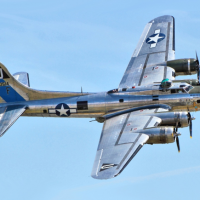
Seventy years on, the aircraft of the Battle of Britain Memorial Flight witness the struggle that followed, and do so in the realm for which they were built – the sky. When the Flight's aircraft are aloft, a scene in Thomas Hardy's novel The Woodlanders comes to mind. Marty watches Giles Winterborne planting trees. ‘How they sigh directly we put 'em upright, though while they are lying down they don't sigh at all', she says. When Giles replies that he has never noticed, Marty places one of the young pines into its hole, and holds up her finger: ‘the soft musical breathing instantly set in which was not to cease night or day till the grown tree be felled'. Engine noise means that we never hear the ‘soft musical breathing' of air flowing over the surfaces of the Flight's aircraft, but because they still fly it is there all the same. It is what makes them live.

The continuing sight and sound of these machines reflects the skills and craftsmanship of the BBMF's engineers, the professionalism of the support staff, and the ability and commitment of the Flight's volunteer aircrew. They in their turn are backed by volunteers, veterans, and guides who give their time and energies to help sustain the Flight's work. As well as being a highly motivated unit within the modern RAF, the Flight is thus also a kind of extended family.

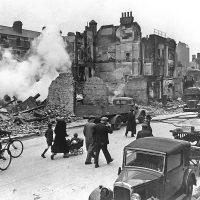
Families extend through time as well as the present. 1938 was the midpoint of my grandmother's life. Not long after, her house was demolished by a German bomb, but late in the 1960s it was not the Battle of Britain about which she began to talk, but the battle of Waterloo . Her grandfather had been there. He had told his son about things he saw, the son told his daughter, and now she was telling me. Nearly two centuries, Jane Austen to the Beatles, had been bridged in three conversations.

The Flight's aircraft move us because they have come to stand for shared experience – all those stories, told and untold, of servicemen and civilian alike. In seventy years' time, how many of these experiences will be known to children who may live long into the twenty-second century? History is about the everyday as well as the exceptional. For those with stories to tell and memories to share, there is still time to pass them on.


Intoduction by Alan Oates:

Alan Oates was born in Whitburn in December of 1920 the son of a miner. Despite, by his account, “being a working class Grammar Schoolboy with poor teeth and eyes that gave me cause for concern”, he was accepted into the RAF in December 1940 for training to become a pilot. He learnt to fly in the United States under the Arnold scheme, flying the Stearman, Vultee and Harvard before receiving his wings (from the Pay parade Sergeant along with his arrears) prior to returning to the UK . Following a Hurricane conversion unit, he was posted as a Tug pilot flying Masters and Lysanders to the Glider Pilot training school at Shobdon. Nine months later he arrived at No 53 OTU to learn to fly the Spitfire.

Alan finally arrived on No 32 Sqn in March 1944 and was very rapidly into the thick of action over the Balkans. It was only one week after his first operational sortie in April 1944 that his aircraft was hit by return machine-gun fire from a train he was strafing and forced to bail out about 10 miles Southeast of Mostar in Yugoslavia . Having, avoided capture and rendezvoused with a group of Tito's Partisans, he eventually arrived back at Bari some 6 weeks later only to be told that he had been reported Missing presumed Killed in Action.

Alan Oates with his Spitfire Mk IX

Alan went on to fly throughout the Balkan campaign, and then moved forward into Greece, in the process losing his 2 tentmates in 2 accidents on consecutive sorties on the same day; being badly shot up by 40mm Anti-aircraft fire; liberating the village of Andravida; and being commissioned. After his last operational flight in Greece , in MJ730, GZ-? known colloquially as the Boss's Query, which still flies today, Alan moved on to Palestine where he served out the war. In Jun 1946 he returned home, was demobbed and then reunited with his family.

Post war, Alan worked for many years as a book-keeper for government backed organisations culminating with English Estates which worked towards developing business and reinvigorating industry in the North East . Both before during and after the War Alan was a keen cricketer, and whilst he has not played for some years he continues to cast a critical eye over the broadcasts of not only this, but many other sports.

Despite having been a Spitfire pilot he never learned to drive a car and always relied on a bicycle for both commuting to work until his retirement and as the basis for a number of touring holidays. His final long distance cycle trip was undertaken at the age of 75 when he completed the Coast to Coast route – after which he hung up his cycle.

He has 4 daughters and 9 grandchildren and one great-grandchild. He retired in 1984 and still lives in the Newcastle area.

In 2001 Alan returned to Greece in the company of 32(The Royal) Sqn as part of its 85 th anniversary celebrations and revisited the village of Andravida and laid wreaths on the graves of his fallen tentmates and wingman in the war cemetery in Athens . In 2003 Alan self-published a book of his memoirs for his grandchildren and modestly titled it ‘One of the Led'. His story is told simply and straightforwardly, without a hint self-aggrandisement and with the unassuming modesty typical of his era. Yet, it is to the thousands of unsung and undecorated heroes like Alan that we owe the greatest thanks. Those who unquestioningly and without succumbing to the tremendous pressures and strains put upon them simply got on and did the job– heroes every one of them.

Alan taken by his colleague Nobby.I had the pleasure of meeting Al Pinner in September 2006, when he flew into Northolt to make the traditional dusk Flypast at the Annual Battle of Britain Reception. After being introduced by the Station Commander as an old WWII pilot, Al kindly invited me to sit in his Mk. IX Spitfire – an invitation I immediately accepted. How the memories flood back – the cockpit smell immediately takes one's mind back over 60 years – the familiar instrument panel is still there, though nowadays the gunsight is removed and there is a slightly more modern radio.

Some time later, I was pleasantly surprised and greatly honoured when Al asked me to write an introduction to the 2008 Brochure. More than a little embarrassed, too, when I realised that these introductions are usually written by senior officers of great distinction – Aces all, with decorations in abundance. Alas, I do not belong in that category. I was one of the Many – one of the thousands who, inspired by the exploits of The Few and their comrades in Bomber Command, elected to "slip the surly bonds of earth and dance the skies on laughter-silvered wings". (I feel sure that many of my contemporaries felt, like me, that flying would be infinitely preferable to being sea-sick in the Navy or route-marching in the Army, and so it proved)

Alan on Paignton Promenade in uniformAs Milton says "They also serve, who only stand and wait" and how true this is in wartime. After completing my flying training with the U.S. Army Air Corps in Georgia and Alabama in March 1942 as part of The Arnold Scheme, I spent 9 months as a Tug Pilot at a Glider Training School, 3 months at Operational Training Unit, weeks at sea and waiting in a Transit Camp in Algiers, 4 months on Flying Control duties in the Tunis area and 2 months on a refresher course in Algeria renewing my association with the lovely Spitfires and Hurricanes last flown at O.T.U., 6 months previously. Eventually, in March 1944, I joined an operational Squadron (No. 32 – still going strong and now The Royal Squadron), flying Spitfires from Eastern Italy across the Adriatic, carrying out ground attacks on trains, motor transport and shipping in and around the Dalmatian Islands, Croatia and Bosnia. (We did not, of course, refer to the separate States then – it was simply Yugoslavia to us.)

We were part of the newly-formed Balkan Air Force, assisting Tito and his Partisan Army in pinning down many thousands of enemy troops who would otherwise have re-inforced their forces in Italy . I think that possibly many people will not have heard of the Balkan Air Force and probably know little about "a small War in the Balkans", but it was a hot little war for those involved. From March to December 1944 (when the retreating enemy was beyond our range from our base at Salonika and politics decreed that we could not pursue them into Yugoslavia ) our Squadron lost at least 12 aircraft to ground fire, but fortunately only 4 pilots. Our sister Squadron had similar casualties. While it was such a delight to fly, I'm afraid the Spitfire was not the most robust machine with which to attack an armoured train.

The boss's queryThe sight and sound of the Battle of Britain Memorial Flight at Airshows and on State Occasions and official Flypasts bring back so many memories, as I am sure they do to all those other survivors who flew in those wonderful aircraft. I remember the sheer delight of mock “low flying” across the top of a bank of cumulus cloud – the fun of doing aerobatics on the way back to base after a successful altitude test, and the dismay of having the carburettor float stay jammed after a slow roll, resulting in a long glide home to a (fortunately successful) “dead-stick” landing. I remember the thrill of each take-off, and the apprehension of returning to base with an armed 250 lb. bomb under each wing, hoping that since I was unable to release them over the target they would stay in place when I made a very gentle landing. Fortunately, they did!

Trevor, Jacky and Alan in Brindisi.I'll not forget that heart-in-mouth feeling when going over the side from a doomed aircraft to earn my Caterpillar Club Membership and enjoy 6 weeks hospitality among the Partisans. Nor will I forget the shock of seeing my Flight Commander shot down alongside me by the opening salvo of some very accurate 20mm.ground fire. And the fright of receiving a direct hit from a 40mm.cannon shell which struck underneath my tail-plane and exploded out on the other side. After regaining control, there was a very nasty grating sound of broken control wires, followed by an anxious return to base, hoping that the remaining control wires would remain intact. But I survived……I'm sure a lot of my contemporaries among the Many will have much more hair-raising memories and horror stories, the like of which I was spared.

Highs and lows – we experienced all kinds of emotions, from the joy of flying such superb aircraft in the company of unforgettable comrades to the grief and sorrow of losing so many of these friends. Let us remember that the B.B.M.F., despite its name, is not simply a memorial to the Few in Fighter Command. Bomber Command were also very busy then and afterwards. As I write, I have before me a newspaper cutting reminding us that on one night in March 1944, Bomber Command lost 64 Lancasters and 31 Halifaxes in a raid on Nuremburg, with the loss of 670 men. 670 men lost in one night, as against 544 casualties in the 4 months of the Battle of Britain. Their losses reached over 50,000 by the end of hostilities.

Alan reunited with the boss's query!It saddens me somewhat, when the Honours List is published every 6 months, to see knighthoods conferred on high-earning sportsmen and managers, pop musicians etc., while R.J. Mitchell, designer of the immortal Spitfire, died plain Mr Mitchell. Likewise, more recently, Mr Geoffrey Quill, Chief Development Test Pilot of the Spitfire, and Mr Alex Henshaw, Chief Test Pilot at Castle Bromwich, where so many thousands of Spitfires were built and tested by him. Hopefully, the debt which the nation owes to such men will be remembered by the continued existence of the Spitfire Society, the Hurricane Society, the Lancaster Association and the Clubs and Societies dedicated to other types of aircraft.

The BBMF, however, remains the principal public link with the past – their very presence in the sky reminding us of the sacrifices made by so many, and not only in the air but on the ground, for without the hard work, skill and dedication of the ground crews and support staff, the success of the air war could not have been achieved. Long may the BBMF continue to fly, so that future generations may know at what cost their freedoms have been preserved.

Young people would, I think, do well to remember the inscription on the war memorial at Kohima in Burma , which seems to me to be applicable to all theatres of war and to all services.

“When you go home, tell them of us and say
For your tomorrow we gave our today.”

Thank you again, Al Pinner, for granting me the privilege, on behalf of the survivors of the Many, of writing this Introduction to the 2008 Brochure.

Have a good season - and Happy Landings.


Home | Foreword | History | The Aircraft | The Crews | Display Dates | Latest News | Guestbook | Visitors Centre
Supporters | Lincolnshire Lancaster Association | Battle of Britain Memorial Flight Association | Official Merchandise

© Crown Copyright 2007 and © Deltaweb International Ltd 2007